Mad Digi

Client project: Famo Pret

Famo Pret: Designing and Building a Clothing Brand's Shopify Store from Scratch

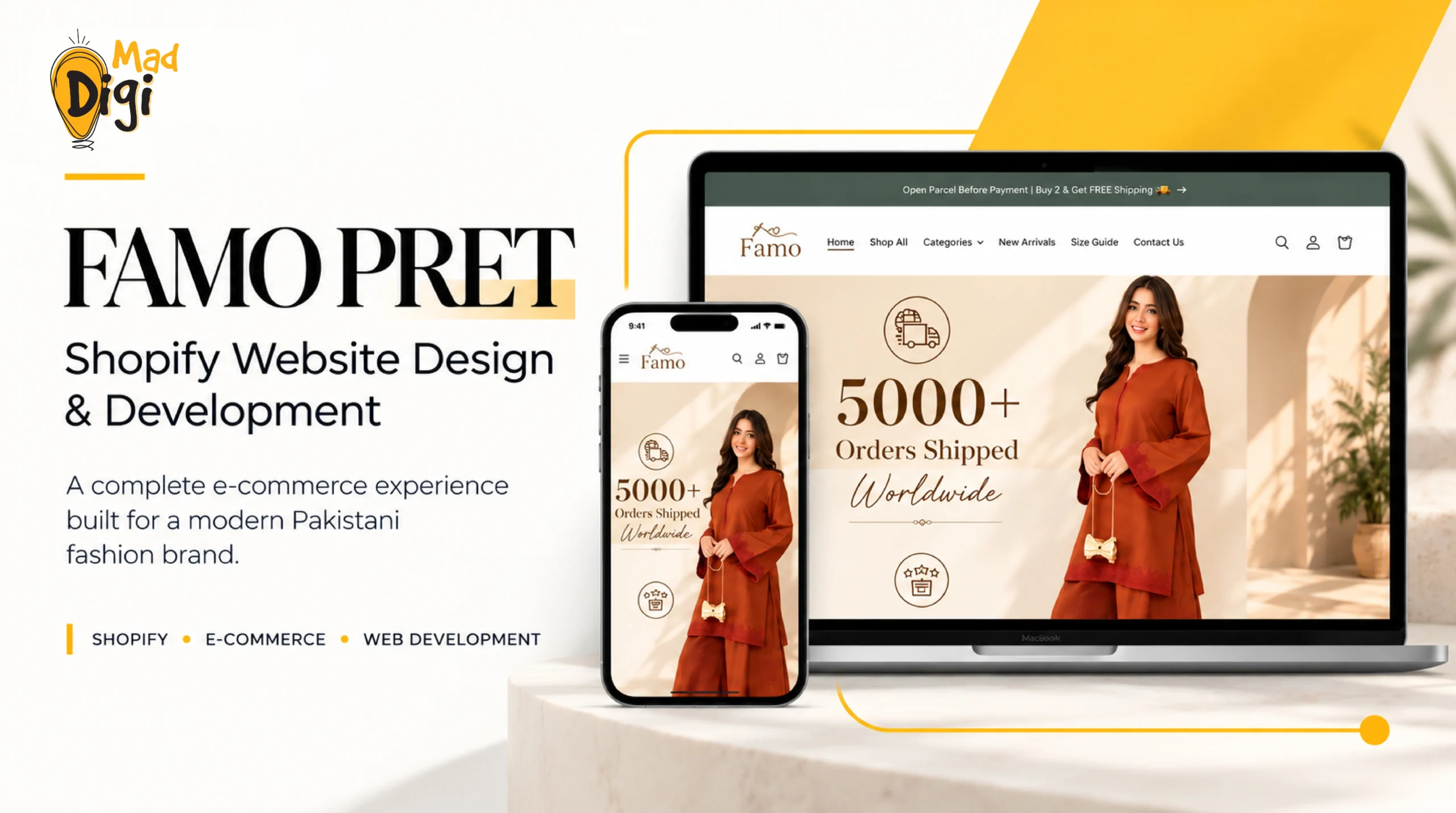
Launching a clothing brand with nowhere to sell it? That's where Famo Pret started in 2025. We designed and built the whole Shopify store, then set up everything a business needs to trade. The result? A store the brand runs itself, with no developer needed for day-to-day work.

  • Website Design
  • Shopify Development
  • Store Setup
Famo Pret: Designing and Building a Clothing Brand's Shopify Store from Scratch

Project overview

Client
Famo Pret
Industry
Women's stitched ready-to-wear: two and three piece suits, farshi shalwar and frocks
Engagement
Project based, delivered (design and build only)
Services delivered
  • Website design
  • Shopify development
  • Full store setup and configuration
Platforms
  • Shopify

The brief

Design and build the entire store, and configure everything needed to run an e-commerce business, so the brand could start selling without a developer for day-to-day work.

Project context

The challenge

Famo Pret is a clothing brand launched in 2025, built around stitched ready-to-wear that balances comfort, style and everyday elegance. The range covers two and three piece embroidered suits, farshi shalwar sets and frocks, at accessible prices.

As a new brand, it needed an online home before anything else could happen. No storefront, no templates, no conventions to inherit. Just a blank page.

Key challenges

  • A brand new label with no existing storefront to build on
  • Stitched ready-to-wear lives or dies on sizing confidence: if a customer's unsure about fit, they don't order
  • Buyers largely pay cash on delivery, so the site has to earn trust before it earns the order
  • Most traffic would arrive from Instagram and TikTok on a phone, making mobile the main design target
  • The catalogue turns over constantly with new drops, so the client had to be able to update it without breaking the design

Project priorities

  • Design a store that lets the clothes do the talking
  • Make size and fabric selection clear at the point of decision
  • Put the trust signals a cautious first-time buyer looks for in plain sight
  • Hand over a store the team can run day to day without touching code

Our approach

The design and build

A design that looks good but can't take an order isn't a store. So we treated the look and the operations as one job, and built the whole thing for the phone first.

  1. A Design That Gets Out of the Way

    The visual approach was deliberately restrained: a minimal layout, generous white space and large photography. For a fashion brand, the product imagery is the design. The interface's job is to step aside.

    Typography and spacing stay clean and consistent, so a catalogue that changes every few weeks always looks considered.

  2. A Homepage That Sells

    Every block on the homepage earns its place. Here's what's on it:

    • A promotional bar with two things that cut buying friction: open parcel before payment, and free shipping on two items
    • Full-width campaign imagery the client swaps for each new drop
    • A new arrivals grid with hover-to-second-image, so shoppers see the detail shot without clicking
    • Sale prices shown against the original, so the value is obvious at a glance
    • A featured product module that sells a hero piece straight from the homepage, size and fabric included
    • A brand story block (which matters for a label nobody's heard of yet), plus links to Instagram, Facebook and TikTok
  3. Navigation and Collection Pages

    The menu follows how the customer shops, not how the warehouse is organised.

    • Categories for two piece suits, three piece suits, farshi shalwar, frocks and sale
    • New arrivals sorted automatically by newest, so it stays current with zero maintenance
    • Shop all, for browsers who don't want to pick a category
    • Consistent product cards across every collection, with sale badging built in
    • Size guide and contact in the main menu, not buried in the footer, because that's what a hesitant first-time buyer looks for
  4. Product Pages, Built Mobile First

    Size and fabric are the two questions that decide a clothing purchase. So the product page answers both, clearly, right where the buyer decides.

    And it was all designed for the phone first, with tap targets, image loading and the cart drawer tested on mobile before desktop. Social traffic doesn't forgive a fiddly mobile site.

    • Multi-image gallery with a modal viewer, so embroidery and fabric detail can be inspected up close
    • Sizes S to XL with clear unavailable states, so nobody adds a size that can't ship
    • Fabric as its own option, since fabric drives the decision in this category
    • Quantity, add to cart and share, all within thumb reach
    • Shipping and policy info linked at the point of decision, not hidden at checkout
  5. Store Setup: Catalogue and Checkout

    Then came the part customers never see, but every order depends on.

    • Shopify account and plan, custom domain connected and secured, brand assets applied across the theme
    • Products uploaded with size and fabric variants, inventory tracking and availability states
    • Automated collection rules where they save time, manual curation where merchandising judgement matters
    • Compare-at pricing configured so discounts display correctly everywhere
    • Checkout with cash on delivery, shipping zones and rates with the buy-two-get-free-shipping rule, tax, currency, order emails and discount codes
  6. Trust, Policies and Handover

    Cautious first-time buyers need reassurance before they'll order. So the trust layer went everywhere it was needed.

    • Privacy, refund, shipping and terms of service policies published, plus a contact page and enquiry route
    • A dedicated size guide page, the most important trust page for stitched clothing
    • Open parcel before payment messaging shown site-wide
    • Email capture in the footer, social profiles connected and analytics in place from launch
    • A client walkthrough, so the team can add products, run sales and swap banners without touching code

How the work fits together

  1. Throughout

    Mobile first

    Tap targets, image loading and the cart drawer tested on the phone before desktop.

  2. Design

    Design direction

    A restrained, image-led layout so the clothes stay the focus.

  3. Build

    Pages

    Homepage, navigation, collection pages and product pages.

  4. Setup

    Catalogue and checkout

    Products, variants, collections, pricing, cash on delivery, shipping and emails.

  5. Trust

    Policies and size guide

    Policies, a dedicated size guide and open parcel messaging across the site.

  6. Handover

    Client walkthrough

    A walkthrough so the team can add products, run sales and swap banners themselves.

The outcome

A store the team runs itself

Famo Pret went from no online presence to a complete, trading Shopify store. The brand can publish a new drop, run a sale, take orders and fulfil them without a developer in the loop.

The store is live and selling across the full range, with new collections added by the client's own team. That was the whole point of building it this way.

Why it works

  • The design stays out of the product's way, so every new collection looks good without a redesign
  • Sizing and fabric are handled at the point of decision, which is where clothing orders are won or lost
  • The trust signals a cautious buyer looks for are visible before checkout, not after
  • Mobile was the main design target, matching where the brand's traffic comes from
  • The client runs the store day to day themselves

Stack

Tools and technologies

  • Ecommerce

    Shopify

    Design, development, catalogue, checkout and the full store setup.

  • Tracking

    Analytics

    In place from launch.

  • Social

    Social channels

    Instagram, Facebook and TikTok connected to the store.

Summary

Conclusion

Famo Pret didn't need a flashy site. It needed one that sells the clothes, answers the sizing question and earns a cautious buyer's trust. Plus, it had to be simple enough for the team to run without us.

The foundation's built. The natural next steps for a brand at this stage are SEO, so the store earns traffic it doesn't pay for, and a properly structured Meta Ads account to scale. Both are services we run for clothing and fragrance brands on Shopify.

Key takeaways

  • Let the Product Be the Design

    In fashion, the photography does the selling. Your interface should step aside, not compete.

  • Answer Sizing Where It Counts

    Put size and fabric right at the point of decision, and a hesitant buyer has one less reason to leave.

  • Build It So You Can Run It

    If every new drop needs a developer, the store slows the brand down. Hand over something the team can manage.

Launching a brand?

Need the store built properly the first time? Book a free consultation; let's get you selling!

Book a Free Consultation