Mad Digi

Client project: Usman Baig Fragrance

Usman Baig Fragrance: From a Slow WordPress Store to a Shopify Brand That Keeps Compounding

Thinking of moving your store to Shopify? Usman Baig Fragrance had loyal customers and strong products. What it didn't have was a store fast enough to keep up, or ads that could prove what they sold. So we moved the brand to Shopify, rescued its search traffic and rebuilt Meta Ads around purchases. Here's how the Shopify migration played out.

  • Shopify Migration
  • SEO
  • Meta Ads
Usman Baig Fragrance: From a Slow WordPress Store to a Shopify Brand That Keeps Compounding
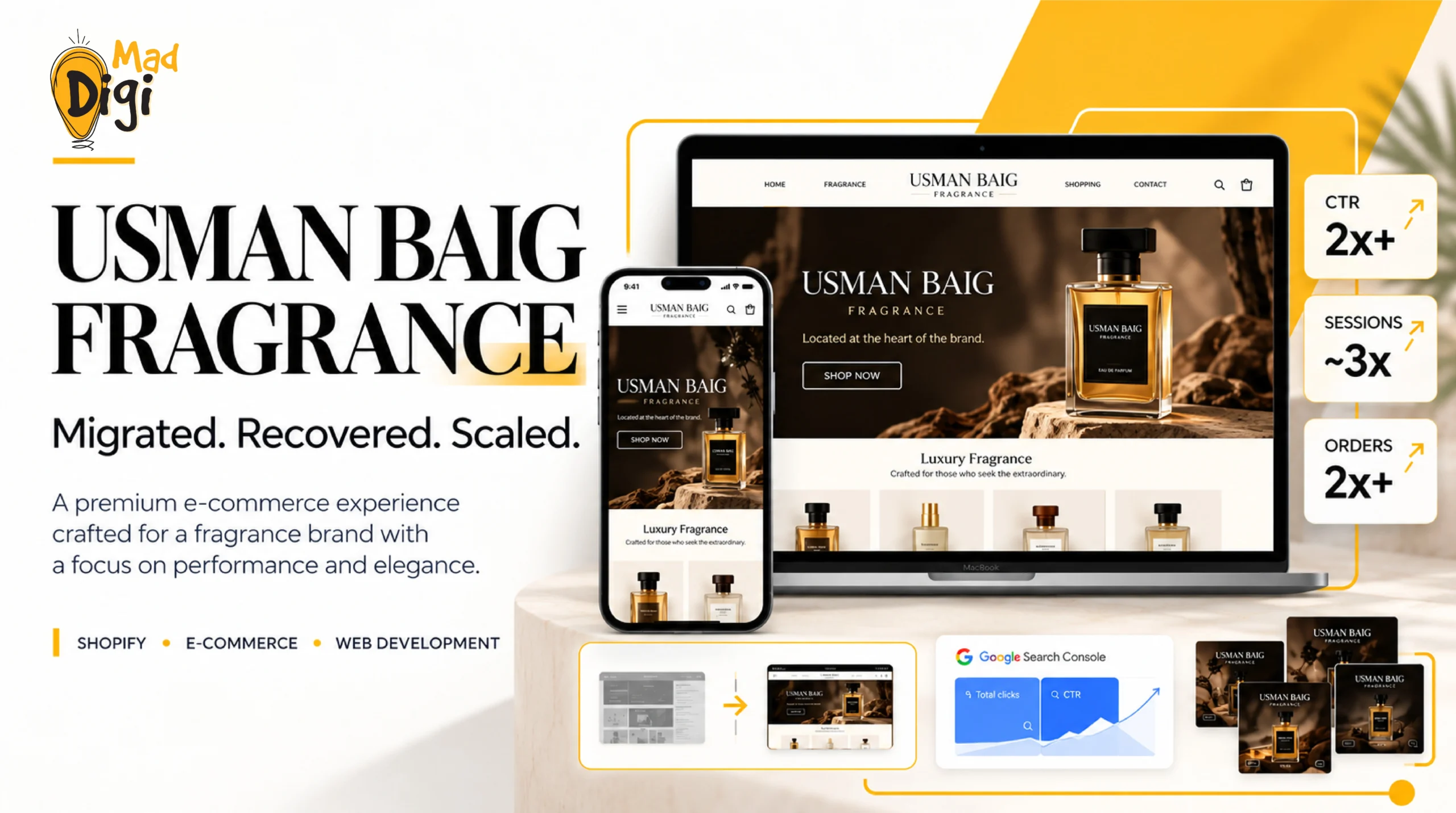
Sessions
~3x
First two months of the new structure vs the period before
Orders
2x+
Same two-month comparison
Revenue
2x+
Period over period, figures kept private
Organic click-through rate
2x+
After the post-migration SEO cleanup

Project overview

Client
Usman Baig Fragrance
Industry
Fragrance (attars, oud, bakhoor and eau de parfums), D2C ecommerce
Location
Lahore, Pakistan
Duration
Ongoing
Services delivered
  • Shopify migration
  • Technical and on-page SEO
  • Meta Ads strategy and management
Platforms
  • WordPress (previous store)
  • Shopify
  • Google Search Console
  • Meta Ads

Primary objective

Move the store from WordPress to Shopify without losing organic search, then turn Meta Ads into a sales channel the brand could actually track.

Project context

The challenge

Here's the thing: the product was never the problem. Usman Baig Fragrance sells premium attars, oud, bakhoor and eau de parfums across Pakistan. There's a physical store in Bahria Orchard, plus a growing online catalogue.

The infrastructure was. The old WordPress store was slow, it struggled with a big catalogue, and checkout wasn't smooth. Moving to Shopify made sense. The catch? A migration is exactly where stores tend to lose their organic traffic (sometimes for good).

And that's what started to happen. Right after the move, organic performance began to slide. Meanwhile, Meta Ads were busy collecting chats, not sales. Nobody could say what the ad spend actually produced.

Key challenges

  • A slow WordPress store struggling with catalogue size, page speed and checkout
  • Organic traffic sliding right after the Shopify move
  • Incomplete and misdirected redirects breaking key product URLs
  • Meta Ads optimised for message conversations, so spend couldn't be tied to sales
  • No retargeting: past customers and engaged non-buyers sat completely untouched

Project priorities

  • Stop the post-migration traffic loss and fix the broken redirects
  • Turn organic search from recovery back into growth
  • Point Meta Ads at purchases, with tracking that proves them
  • Use existing demand first, then build new demand on top

Our approach

Strategy and delivery

We split the work into three phases: stop the damage, grow organic search, then rebuild Meta Ads around sales. Here's what each one looked like.

  1. Shopify Migration and Damage Control

    First, we took over the Shopify migration and audited what had actually carried across. Then we rebuilt the full URL map.

    The audit turned up a batch of broken and misdirected redirects. A store handle issue was breaking canonical paths, and a high-intent attar product was resolving to the wrong page entirely. So we mapped every legacy URL with ranking value to its correct Shopify page. No dumping it all on the homepage.

    • Full WordPress-to-Shopify URL map
    • Broken and misdirected redirects corrected
    • Canonical paths fixed at the store handle level
  2. Stabilise, Then Grow Organic

    Once the bleeding stopped, we switched from recovery to growth.

    The clearest sign it worked? Click-through rate. Organic CTR more than doubled, because the listings finally matched what buyers were actually searching for.

    • Technical cleanup across indexation, canonicals and sitemap coverage
    • Titles and meta descriptions rewritten around how Pakistani buyers actually search for attar, oud and bakhoor
    • Stronger collection and product page content, so category pages could rank on their own
    • Ongoing Search Console monitoring, so new issues get caught within days, not quarters
  3. Rebuild Meta Ads Around Sales

    Chats are nice. Sales are better. So we restructured the account end to end and pointed ad spend at purchases, with tracking that could prove them. Think of it as swapping a guest book for a till receipt.

    • Switched from message conversations to purchase-optimised campaigns, tracked through the Meta Pixel and Conversions API
    • Built a retargeting layer for past customers and engaged users who'd never bought, turning a large dormant list into repeat revenue
    • Opened cold prospecting to win new buyers, instead of leaning only on existing demand
    • Added a brand awareness tier at the top, so the prospecting pool keeps refilling instead of burning out
    • Fixed audience overlap and frequency problems that were wearing out warm audiences

Execution timeline

  1. Phase 1

    Migration audit

    Checked what carried across from WordPress and rebuilt the URL map.

  2. Phase 1

    Redirect fixes

    Corrected broken and misdirected redirects, including the store handle and attar product issues.

  3. Phase 2

    Technical SEO

    Cleaned up indexation, canonicals and sitemap coverage.

  4. Phase 2

    On-page rewrites

    Rewrote titles and meta descriptions around real buyer searches, and strengthened collection and product page content.

  5. Phase 3

    Meta Ads rebuild

    Moved to purchase campaigns with Pixel and Conversions API, plus retargeting, prospecting and awareness layers. Fixed audience overlap and frequency.

  6. Ongoing

    Monitor and build

    Search Console monitoring, plus deeper category coverage, wider creative testing and a stronger retention layer.

Evidence

Results and performance

Within two months of the new structure, the store moved into a different bracket. Every number here is period over period, from the brand's own Shopify and Search Console reporting. (We don't publish client revenue figures.)

Sessions
~3x
First two months of the new structure vs the period before
Organic traffic
Decline → Growth
The post-migration slide reversed

Key outcomes

  • Sessions close to tripled, and orders and revenue more than doubled, within two months
  • Organic search went from a post-migration decline back to steady growth
  • Meta Ads spend now leads to purchases the team can track
  • Not a one-month spike: each period has built on the one before, and the brand's still scaling
Before vs after Period over period, from Shopify and Search Console.
MetricBeforeAfterChange
Sessions Previous period First two months Close to 3x
Orders Previous period First two months More than 2x
Revenue Previous period First two months More than 2x
Organic click-through rate Before cleanup After cleanup More than 2x
Organic traffic Sliding after migration Growing again Reversed
Meta Ads objective Message conversations Purchases (Pixel + CAPI) Sales now trackable
Retargeting None Past customers and engaged non-buyers Dormant list turned into repeat revenue

Period-over-period movement from Shopify and Search Console. Client revenue and order figures are not published.

Stack

Tools and technologies

  • Ecommerce

    Shopify

    The new store, and the source for sessions, orders and revenue.

  • SEO

    Google Search Console

    Indexation checks, ongoing monitoring and click-through tracking.

  • Paid social

    Meta Ads

    Campaign build across retargeting, prospecting and awareness.

  • Tracking

    Pixel and Conversions API

    Meta purchase tracking, so ad spend ties to real orders.

Summary

Conclusion

Usman Baig Fragrance didn't need a better product. It needed a store and an ad account that could keep up with the one it had.

So we treated the migration as an SEO project, not an IT task, and pointed ad spend at purchases. The result? Organic and paid now work as one system: the searches the ads create land on a fast, well-built store.

Next up: deeper category coverage, wider creative testing and a stronger retention layer to lift repeat purchases.

Key takeaways

  • Treat Migration as SEO

    A platform move is where rankings go missing. Every old URL needs a correct home on the new store, and the homepage isn't it.

  • Pay for Purchases, Not Chats

    If your tracking can't prove a sale, you can't judge the spend. Harsh, but true.

  • Harvest First, Then Build

    Win back past customers before chasing cold audiences, then keep the funnel fed at the top.

Want results like these for your brand?

Planning a Shopify migration, or tired of ads that only bring in chats? Book a free audit of your store and ad account; let's find where your growth is hiding!

Book a Free Audit